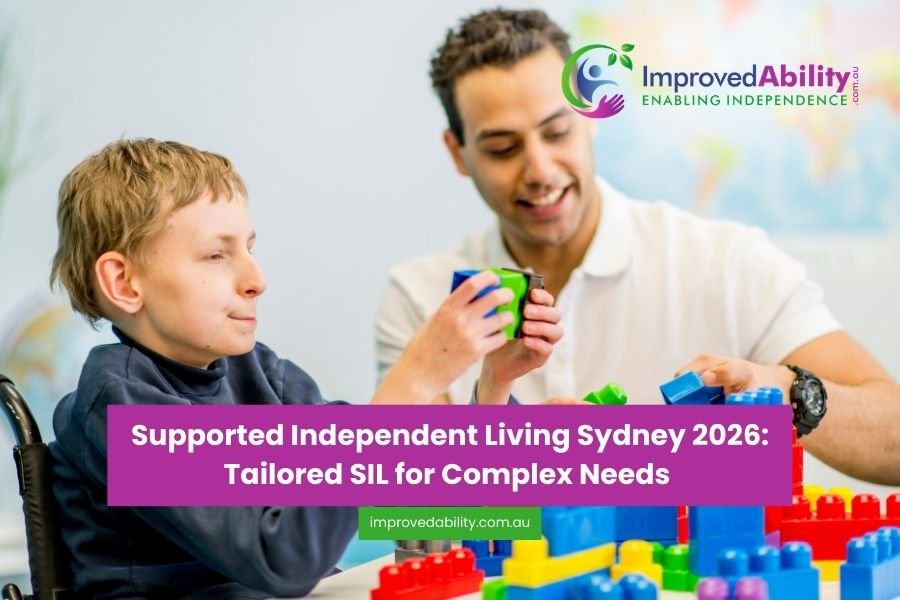
For many Australians living with disability, the question of where and how to live is one of the most significant they will ever face. In 2026, supported independent living Sydney services have matured considerably — but so have the expectations of participants, families, and the NDIS itself. Today, a quality SIL arrangement is not simply about having a roof overhead and a support worker nearby. It is about a personalised, human-centred life built around each individual’s goals, routines, and dignity.
At Improved Ability, this philosophy sits at the core of everything they do — and for participants across Sydney’s metropolitan area with complex and high-intensity support needs, that difference is transformative.
What Is Supported Independent Living — and Why Does It Matter in 2026?
Supported Independent Living (SIL) is an NDIS-funded support category that enables people with disability to live as independently as possible, with assistance tailored to their daily requirements. Whether that means help with morning routines, medication management, meal preparation, or complex clinical care, SIL bridges the gap between living fully and living safely.
In 2026, demand for SIL personalised plans Australia-wide has never been higher. The NDIS has placed growing emphasis on outcomes-driven funding, pushing providers to demonstrate genuine progress toward participants’ goals — not just task completion. This shift has raised the bar for what a quality SIL provider looks like, and rightly so.
Participants are no longer passive recipients of care. They are rights-holders with plans, preferences, and ambitions. The best SIL providers in Sydney understand this, designing living arrangements that flex around the person — not the other way around.
The Challenge of Complex and High-Intensity Needs
For many participants, the journey to finding the right SIL placement is genuinely difficult. Standard shared living arrangements can fall short when someone’s needs include PEG feeding, wound care management, complex behavioural support, or round-the-clock clinical oversight. These individuals require providers that are not just willing — but genuinely equipped — to deliver high-intensity care shared living environments.
The risks of mismatched placement are significant. When a participant’s clinical or behavioural needs exceed a provider’s capacity, quality of life suffers, support workers burn out, and families carry enormous stress. For participants with acquired brain injuries (ABI), autism spectrum disorder, or significant physical disabilities, getting the right fit from the beginning is not a luxury — it is essential.
This is why the assessment and planning phase matters as much as the support itself. A thorough intake process, honest conversations about capacity, and a willingness to involve allied health professionals from the outset separates outstanding SIL providers from adequate ones.
What a Genuinely Personalised SIL Plan Looks Like
The word “personalised” appears in nearly every SIL provider’s marketing. But what does it actually mean in practice?
A genuinely personalised SIL plan begins before move-in day. It starts with deep listening — learning about the participant’s history, preferences, cultural background, daily rhythms, communication style, and long-term aspirations. It involves their family and informal supports, their allied health team, and — most importantly — the participant themselves.
From there, a tailored plan is built around specific goals. For one person, that goal might be building the confidence to catch public transport independently. For another, it might be maintaining stability, comfort, and connection with loved ones while receiving complex medical care at home. Neither goal is more or less valid. What matters is that the plan genuinely reflects that person’s life — not a generic template.
At Improved Ability, personalised support plans are developed with exactly this level of care. No two residents are treated the same, because no two people are the same. Their team of trained support workers, carers, and allied health professionals works collaboratively to ensure that each plan evolves as the participant’s needs and goals evolve.
Compassionate 24/7 Support: More Than a Roster
One of the most important features of quality SIL for complex needs is compassionate 24/7 support — and the word “compassionate” carries real weight here. Around-the-clock support is not simply a staffing solution. It is a commitment to being genuinely present, responsive, and caring at every hour of the day, including the hard ones.
Participants with high-intensity needs may experience medical emergencies, episodes of distress, or moments of vulnerability at any time. The difference between a support worker who is physically present and one who is both present and genuinely invested in that person’s wellbeing is profound. Families choosing SIL for a loved one are not just checking that a carer is rostered on overnight. They are trusting that person with someone they love.
Improved Ability’s commitment to 24/7 support goes hand-in-hand with their investment in staff training and culture. Their team includes professionals capable of delivering high-intensity clinical support — from complex wound care to medication administration — alongside the interpersonal warmth that makes a house feel like a home.
Accommodation Options Across the Sydney Metropolitan Area
Sydney is a diverse city, and SIL participants have varying preferences about where and how they live. Improved Ability offers several accommodation models to match different needs and circumstances.
Shared SIL accommodation allows participants to have their own private space while sharing common areas with others. For many, this model offers a valuable social dimension — a built-in community — alongside the support they need. Independent SIL accommodation suits those who prioritise privacy, with support provided as required throughout the day. For participants navigating transitions — between hospital and home, or between living situations — short-term and medium-term accommodation options offer a stable, supported bridge.
For those with specialist needs, Improved Ability also delivers clinical and behavioural support within the living environment, tailoring the physical space and staffing model to match the individual’s requirements. Their locations across East Sydney, the Inner West, Canley Heights, Austral, and Guildford mean that participants can often remain connected to familiar communities, local services, and support networks while accessing high-quality SIL.
Navigating the NDIS with Confidence
For many families, the NDIS can feel overwhelming. Understanding how SIL funding is structured, what is and is not included in a plan, and how to advocate for the right supports is a full-time undertaking in itself.
Improved Ability takes the complexity out of this process. As a fully registered NDIS provider meeting strict quality and safety standards, they guide participants and families through every stage — from understanding existing plan funding to advocating for the right supports at plan reviews. Transparent communication is not a feature; it is a founding principle. Families are kept in the loop, participants are respected as decision-makers, and nothing happens without genuine informed consent.
Taking the Next Step
For participants with complex and high-intensity needs, finding the right supported independent living arrangement in Sydney takes time, care, and a provider willing to go the distance. The right SIL placement does not just meet basic needs — it creates the conditions for a genuinely good life.
If you or a loved one is exploring SIL options in Sydney in 2026, Improved Ability invites you to start with a free consultation. Their team is ready to listen, to ask the right questions, and to work alongside you to build a plan that truly fits.
Contact Improved Ability today:
📞 0448 696 446
📧 info@improvedability.com.au
🌐 www.improvedability.com.au
Because everyone deserves to live life on their own terms — with the right support behind them.