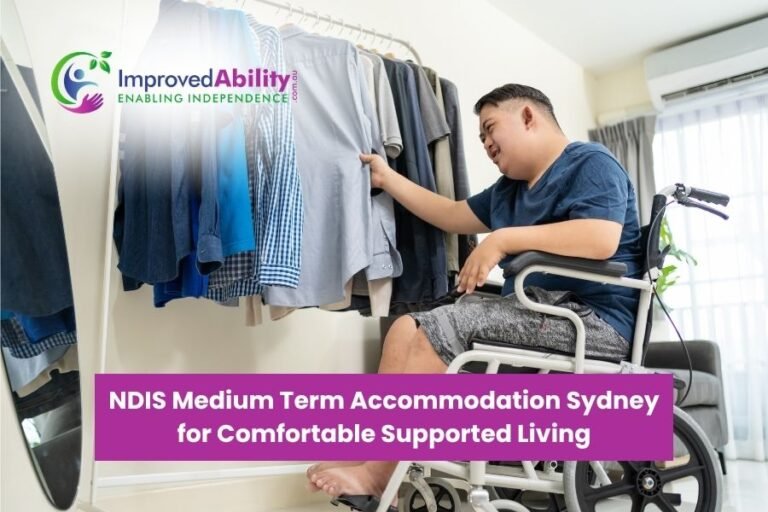

Finding the right place to live in Sydney can be challenging, especially if you’re living with a disability and going through a period of change. Waiting to have an SDA home ready, leaving hospital care, or simply having a safe place to stay, the need to find the right accommodation may become overwhelming.
That’s exactly where medium term accommodation NDIS Sydney comes into the picture. It is the safety net that many people don’t even realize they have access to. But here is the problem: most NDIS guides make MTA sound like a confusing legal contract or clinical procedure. It isn’t.
At its heart, MTA is simply about giving you a comfortable, fully supported place to stay while you wait for your “forever” home to be ready. At Improved Ability, we’ve seen firsthand how much stress this “waiting game” causes. We don’t just offer a bed; we offer a way to keep your independence moving forward while your life is in transition.
In this guide, we are skipping corporate fluff. We’re going to show you exactly how MTA works in Sydney, why it’s a lifesaver for carers, and how you can get it into your plan without the headache.
1. What’s the Deal with Medium Term Accommodation (MTA)?
If you’re new to the NDIS world, the number of acronyms alone is enough to give you a massive headache. MTA stands for Medium Term Accommodation, but you can basically think of it as “bridge housing.” It’s a type of transitional housing NDIS Sydney participants can use for a short window, usually up to 90 days.
Take it as the safety net that you catch between homes. It is intended especially for those individuals who already have a permanent location arranged but who simply cannot get in quite yet.
Why would you need a “bridge”? Living in Sydney, we see all sorts of reasons, but these are the big ones:
- Building Delays: Your new SDA apartment is scarcely complete, but the finishing touches, such as those special rails or ramps in the bathroom, are running late by one month.
- Getting out of Hospital: You are medically fit to walk out of the ward, and your home is not safe yet, and you are expected to stay there. You need a place to stay while the modifications are being hammered out.
- Waiting on the Paperwork: Maybe you’ve found the perfect SIL (Supported Independent Living) house, but the NDIS is still crunching the numbers on your final support hours.
MTA exists, so you aren’t stuck in a hospital ward or a nursing home when you don’t need to be. It’s about keeping you in the community where you actually belong.
2. The Real MTA Benefits: A Much-Needed Carer Break
We can’t talk about housing without talking about the people who provide the bulk of the support at home. One of the biggest, yet least talked about, MTA benefits is the carer break it provides.
Being a primary carer in a city as busy as Sydney is rewarding, but it’s also exhausting. We often see situations where a career hits a point of total burnout, or perhaps they need their own medical procedure and can’t provide support for a few weeks.
Why MTA is better than “standard” respite:
While Short Term Accommodation (STA) is great for a weekend away, MTA provides a more stable, 90-day window. This allows:
- The Participant: To get a chance to be in a different atmosphere and develop in another environment.
- The Carer: To have a moment, rest and be able to give high quality care in the long term.
It’s about sustainability. A short stay in MTA can prevent a complete breakdown of the home environment, keeping families together for longer.
3. Temporary Independence Support: It’s More Than Just a Room
The first thing that comes to the minds of individuals when temporary housing is mentioned is a hotel room that is sterile and a cold boarding house. But temporary independence support through Improved Ability is a completely different experience.
We don’t want you to press “pause” on your life goals just because your housing is temporary. While you are staying in MTA, the focus remains on your independence.
- Developing Daily Skills: MTA is a perfect “test run” for living independently. You can practice meal planning, manage your own laundry, or use new assistive technology in a low-pressure environment.
- Maintaining Your Routine: Our MTA spots are located in real Sydney neighborhoods. This is to say that you are close to the shops, the parks, and the transport connections that you require. You do not disappear in the background; you remain a participant of society.
4. Why Transitional Housing in Sydney is Unique in 2026
Sydney is a world-class city, but let’s be real; it’s crowded, expensive, and the rental market is a nightmare. Finding transitional housing NDIS Sydney participants can actually access is becoming a major challenge.
In 2026, we are seeing a massive shift in what participants want. Individuals are shunning the old-fashioned group home designs. They desire current and convenient spaces which look like an actual house.
The Local Factor
If you’ve lived your whole life in the Inner West, the last thing you want is to be moved to a facility two hours away just because it’s “temporary.” At Improved Ability, we understand that “home” includes your local GP, your favorite café, and your friends. We work across Sydney to find MTA options that keep your life as normal as possible.
5. Who is Actually Eligible for MTA?
The NDIS has some pretty strict rules about who gets MTA funding. You can’t just get it because you “fancy a change of scenery.” To have it included in your plan, you generally need to prove two things to the planners:
- You have a permanent home confirmed: You need a “light at the end of the tunnel.” This could be a letter from a provider saying your SDA is almost ready, or a signed agreement for a SIL property.
- You cannot live in your current home right now: This might be because your current house is being sold, it’s no longer accessible for your needs, or you are being discharged from a health facility.
A Quick Tip on Evidence: The NDIS loves paperwork. If you want MTA approved, you’ll need a solid report from your Occupational Therapist (OT) or your Support Coordinator explaining exactly why your current situation is a risk to your health or independence.
6. Navigating the NDIS “Change of Circumstances”
You don’t have to wait for your yearly plan to review to get an MTA. If your housing situation changes suddenly, for example, if your landlord ends your lease or your health takes a turn, you can lodge what’s called a Change of Circumstances (CoC).
This is where having a provider like Improved Ability on your side helps. We can help you gather the right evidence, so the NDIS understands the urgency. We’ve seen cases where MTA is approved in just a few days when the evidence is clear, and the need is urgent.
7. Life in MTA: What Does a Day Look Like?
The greatest fear of people is that MTA will become a hospital ward. We take the extra effort at Improved Ability to ensure that does not happen.
- Your Space, Your Way: You are welcome to bring stuff of your own: your clothes, your laptop, your favorite pillow. It’s your home for the next three months.
- Flexible Support: You can usually keep your regular support workers. They can come into the MTA property to help you with your daily routine, just like they would be at your permanent house.
- Visitors Welcome: It’s your life. You can invite friends and family over to have a cup of tea or a meal. Maintaining such social networks is a massive portion of your health.
8. Managing the Costs: What Does the NDIS Pay For?
This is one of the areas of misunderstanding. Here is the breakdown:
- What the NDIS pays: They cover the “bricks and mortar” cost of the stay. This includes the rent of the room or apartment and the basic utilities like water and gas.
- What YOU pay: You are still responsible for your “board” or “everyday” costs. This includes your groceries, your phone bill, your internet, and your personal items.
The NDIS assumes that even if you weren’t in MTA, you’d still be paying for food and a phone, so they don’t cover those parts.
Frequently Asked Questions
How long can I actually stay?
The standard limit is 90 days. In very rare cases, if there is a massive delay that is completely out of your control (like a legal dispute over your new home), the NDIS might extend it. But they really want to see you in your permanent home within that 3-month window.
What if I don’t have a permanent home lined up yet?
This is tricky. If you don’t have a confirmed “next step,” the NDIS might suggest other types of support, like STA (Short Term Accommodation) or ILO (Individualised Living Options). MTA is specifically for that “bridging” period.
Is MTA available in Western Sydney?
Absolutely. We provide medium term accommodation NDIS Sydney wide, from Parramatta and Blacktown out to Penrith and down to the South West.
Can I move straight from the hospital to MTA?
Yes, and for many people, this is the best option. It allows you to continue your rehab in a much more comfortable environment while your home modifications are being finished.
The Link Between MTA and Permanent Independence
MTA isn’t just about a bed; it’s about the next chapter of your life. For many of our participants, their time in MTA is the first time they’ve lived away from their parents or out of a large facility.
It’s an incredible opportunity to see what you are capable of. We’ve had participants discover they love cooking, or that they are great at managing their own schedule, all because they had that 90-day “safe space” to try it out.
Why Improved Ability is Your Best Move in Sydney
We know there are a lot of NDIS providers in the Sydney area. We are too proud to be the same. We do not view you as a figure on a spreadsheet; we view you as a human being that is experiencing a big life change.
The Improved Ability Difference:
- Speed: We know that housing issues are often urgent. We move quickly to check eligibility and find a suitable spot.
- Accessibility First: We don’t just “make do.” Our properties are vetted to ensure they actually meet your physical needs.
- Human Connection: We stay in touch. We stop by and ask you how you are doing and get you ready to move into your new residence.
Conclusion
Finding your way through the NDIS housing maze can feel overwhelming, particularly in a major and bustling city like Sydney. Now you do not need to do it all yourself. Medium term accommodation NDIS Sydney is here so that when you are awaiting your permanent house, you have a safe, conducive place to land.
You may be a participant seeking the bridge to independence, or the one who caregivers and is so much in need of a rest to refuel, Improved Ability is there to assist you. We will not dwell on the jargon, we will work through the details, and we will ensure that you have a place of the kind of feeling like home even though it may be only 90 days.
Ready to secure your transitional home?
If you’re stuck in that “in-between” phase and need a place to stay that actually supports your goals, let’s have a chat. We can look at your current plan, discuss your needs, and find a solution that works for you.
Contact Improved Ability Today